
The Unexpected Legacy of Divorce
Judith S. Wallerstein, Julia M. Lewis, and Sandra Blakeslee • 2000
Grand Central Publishing
ISBN: 978-0786863945
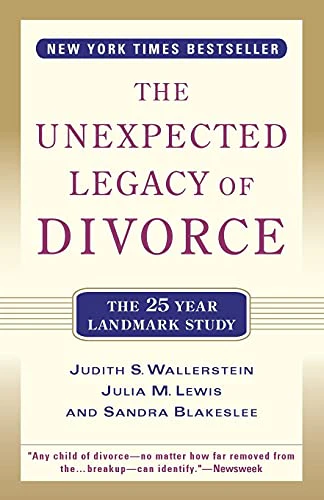
The Unexpected Legacy of Divorce
reading highlights & reference
from Amazon: Divorce is at once a widespread reality and a painful decision, so it is no surprise that this landmark study of its long-term effects should both spark debate and find a large audience.
In this thought-provoking book, Judith Wallerstein explains that, while children do learn to cope with divorce, it in fact takes its greatest toll in adulthood, when the sons and daughters of divorced parents embark on romantic relationships of their own. Wallerstein sensitively illustrates how children of divorce often feel that their relationships are doomed, seek to avoid conflict, and fear commitment. Failure in their loving relationships often seems to them preordained, even when things are going smoothly.
As Wallerstein checks in on the adults she first encountered as youngsters more than twenty-five years ago, she finds that their experiences mesh with those of the millions of other children of divorce, who will find themselves on every page.
Highlights:
...Up until thirty years ago marriage was a lifetime commitment with only a few narrow legal exits such as proving adultery in the courts or outwaiting years of abandonment. American cultural and legal attitudes bound marriages together, no matter how miserable couples might be. Countless individuals were locked in loveless marriages they desperately wanted to end, but for the most part they had no way out. Then, in an upheaval akin to a cataclysmic earthquake, family law in California changed overnight. A series of statewide task forces recommended that men and women seeking divorce should no longer be required to prove that their spouse was unfaithful, unfit, cruel, or incompatible. It was time, they said, to end the hypocrisy embodied in laws that severely restricted divorce. People should be able to end an unhappy marriage without proving fault or pointing blame.
The prevailing climate of opinion was that divorce would allow adults to make better choices and happier marriages by letting them undo earlier mistakes. They would arrive at an honest, mutual decision to divorce, because if one person wanted out, surely it could not be much of a marriage.
These attitudes were held by men and women of many political persuasions, by lawyers, judges, and mental health professionals alike. The final task force that formulated the new no-fault divorce laws was led by law professor Herma Kay, who was well known as an advocate for women’s rights. In 1969, Governor Ronald Reagan signed the new law and people were jubilant. It was a time of hope and faith that greater choice would set men and women free and benefit their children. Within a few years, no-fault divorce laws spread like wildfire to all fifty states. People all across the country were in favor of change.
But what about the children? In our rush to improve the lives of adults, we assumed that their lives would improve as well. We made radical changes in the family without realizing how it would change the experience of growing up. We embarked on a gigantic social experiment without any idea about how the next generation would be affected. If the truth be told, and if we are able to face it, the history of divorce in our society is replete with unwarranted assumptions that adults have made about children simply because such assumptions are congenial to adult needs and wishes...Introduction/ pg. xxi
Children in postdivorce families do not, on the whole, look happier, healthier, or more well adjusted even if one or both parents are happier. National studies1 show that children from divorced and remarried families are more aggressive toward their parents and teachers. They experience more depression, have more learning difficulties, and suffer from more problems with peers than children from intact families. Children from divorced and remarried families are two to three times more likely to be referred for psychological help at school than their peers from intact families. More of them end up in mental health clinics and hospital settings. There is earlier sexual activity, more children born out of wedlock, less marriage, and more divorce. Numerous studies2 show that adult children of divorce have more psychological problems than those raised in intact marriages.Introduction/Cherished myths/ pg. xxiii
That voice belongs to the children of divorce now grown to adulthood. In this book, you will hear them challenge these myths firsthand. Now that they are grown up, have marriages, divorces, and children of their own, they speak with an authority we dare not ignore.
Adult children of divorce are telling us loud and clear that their parents’ anger at the time of the breakup is not what matters most. Unless there was violence or abuse or unremitting high conflict, they have dim memories of what transpired during this supposedly critical period. Indeed, as youngsters then and as adults now, all would be profoundly astonished to learn that any judge, attorney, mediator—indeed, anyone at all—had genuinely considered their best interests or wishes at the breakup or at any time since. It’s the many years living in a postdivorce or remarried family that count, according to this first generation to come of age and tell us their experience. It’s feeling sad, lonely, and angry during childhood. It’s traveling on airplanes alone when you’re seven to visit your parent. It’s having no choice about how you spend your time and feeling like a second-class citizen compared with your friends in intact families who have some say about how they spend their weekends and their vacations. It’s wondering whether you will have any financial help for college from your college-educated father, given that he has no legal obligation to pay. It’s worrying about your mom and dad for years—will her new boyfriend stick around, will his new wife welcome you into her home? It’s reaching adulthood with acute anxiety. Will you ever find a faithful woman to love you? Will you find a man you can trust? Or will your relationships fail just like your parents’ did? And most tellingly, it’s asking if you can protect your own child from having these same experiences in growing up.
Not one of the men or women from divorced families whose lives I report on in this book wanted their children to repeat their childhood experiences. Not one ever said, “I want my children to live in two nests—or even two villas.” They envied friends who grew up in intact families. Their entire life stories belie the myths we’ve embraced.Introduction/Cherished myths/ pg. xxv